_edited_edited.png)
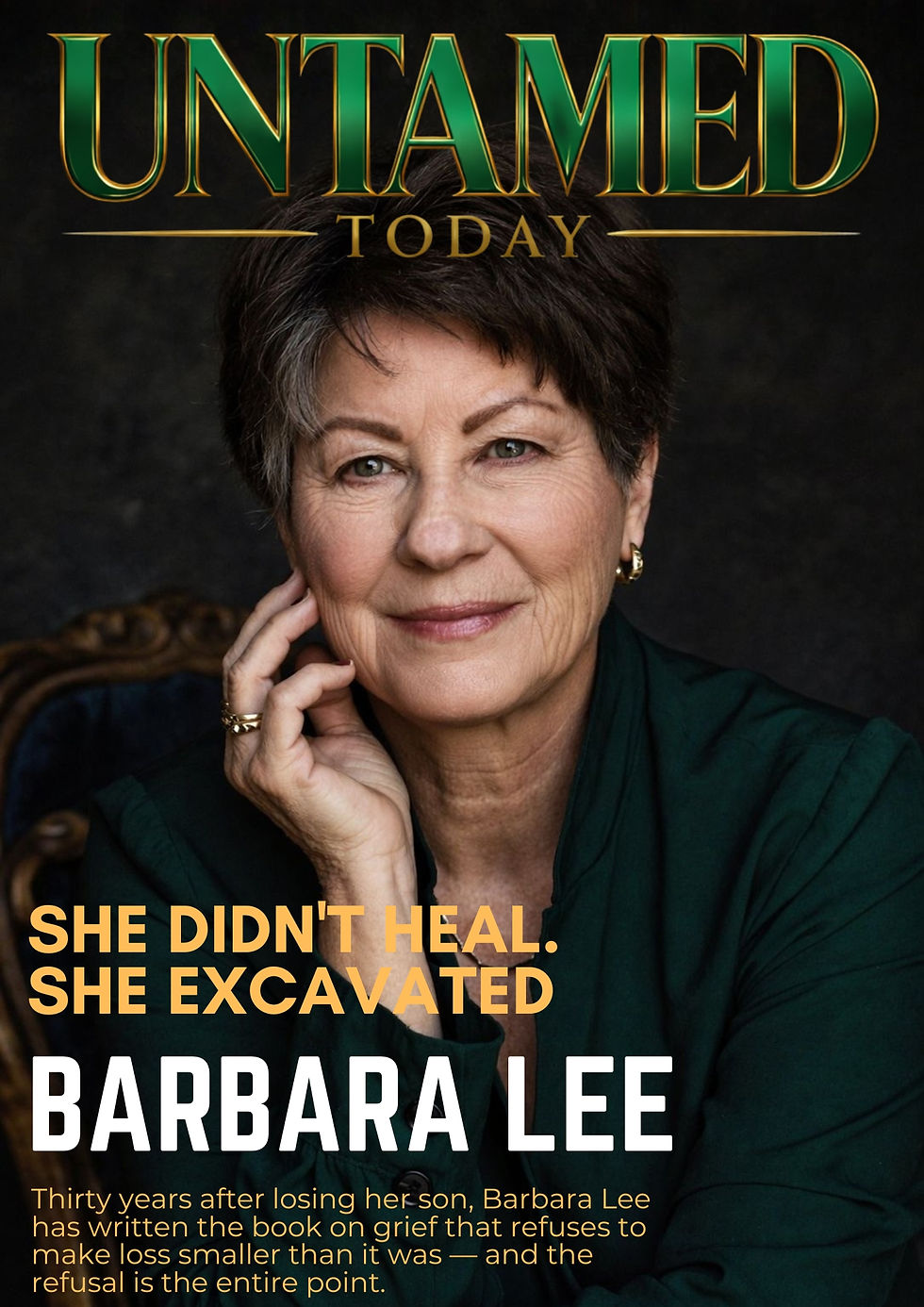
Una vida, de cerca
The Soul Gardener
Ella ha estado en el interior de la oscuridad que describe. Precisamente por eso deberías escucharla. El jardinero del alma: un camino estacional de sanación a través de la pérdida y el duelo.
ENTREVISTAS DE UNTAMED HOY
VIVIENDO EL CÓDIGO
Bárbara Lee
UNTAMED TODAY · THE INAUGURAL ISSUE · SUMMER 2026
A note from our founder

The woman you are about to meet is my mother. I want you to sit with that for a moment before you read a single word of this interview, because it changes the weight of everything that follows.
My mother lost my brother John Henry on January 20, 1995. I watched her carry that. I watched her disappear into it. And I watched her, slowly, painfully, without any guarantee it would work, find her way back. What I could not have known then is that she was doing something more than surviving. She was building a map. For herself first. And then, because that is who she is, for everyone else who would ever need one.
I built UNTAMED TODAY because I kept looking for a platform worthy of people like her. People who tell the truth. People who do the work. People who refuse to make their pain, their art, their ambition, or their life smaller than it actually is.
I didn't have to look far for our first story.
Mom, thank you for writing the book you were afraid to write. Thank you for staying in the cave long enough to find the way out. And thank you for showing me, my entire life, what it looks like to keep becoming.
Jesse James Ferrell, Founder and Visionary, UNTAMED TODAY
The Soul Gardener
She didn't heal. She excavated. Thirty years of grief. Fifteen drafts of a single chapter. A lifetime spent learning that some losses don't dissolve; they compost. The result is a book that refuses to make loss smaller than it actually is, and a woman who has earned every word of it.
Barbara Lee speaks the way people speak when the wrong words have cost them something real.
She is precise about language. She does not say healed when she means something else. She does not say recovered. Recovery, she will tell you, implies a return, a reconstitution of who you were before. What she has done over thirty years is not a return. There is no version of her left that could return.
She is, instead, what she has become. Mother of six. Reflexology practitioner. Wedding officiant. Student of Mind/Body Transformational Psychology. A woman married three times. A woman who lost a baby brother before she had language for loss. A woman who carried a wound from the summer before her sixth birthday for seven decades, quietly, without funeral, without permission to call it what it was.
And, on January 20, 1995, the mother of a son named John Henry, who was killed in a car accident, and who has been gone for thirty years.
She will tell you plainly: he is still gone. The absence did not dissolve. It did not transform into something softer over time. What changed, what took thirty years of work, one collapsed grief workshop in front of a single attendee, and fifteen drafts of one impossible chapter to understand, is her capacity to carry it.
The Soul Garden: A Seasonal Path of Healing Through Loss and Grief is the book that emerged from that capacity. It is not a framework. It is a conversation, the kind that begins when someone who has genuinely survived something sits down, looks you in the eye, and refuses to make it smaller than it was.
I spent years thinking the pain would eventually stop pressing. And then I realized it wasn't pressing. It was just present. There's a difference. One is trying to destroy you. The other is trying to tell you something.
Arrival
We begin where every honest conversation about grief must begin: in the body.
“Grief lives somewhere specific,” she says. “It's not abstract. It's not emotional weather. It's a place. Mine was in my chest, but lower than where most people point when they mean the heart. Somewhere that felt like compression. Like something had been removed and the surrounding tissue hadn't yet gotten the news.”
She pauses. She does this, pauses with intention, the way people do when they have learned that rushing toward an answer is just another form of avoidance.
The workshop that broke open

In 2006, eleven years after John's death, Barbara Lee stood in front of one person, a single attendee, and tried to teach a grief workshop. She had the outline. She had the structure. She had, she believed, enough distance from the loss to be useful to someone else inside theirs.
She did not make it ten minutes before she dissolved.
“I was sobbing. Stuttering. I couldn't get through a single paragraph about healing without falling completely apart in front of this poor woman who had come to be helped and was now watching me have a breakdown.” She laughs, that particular laugh grief survivors learn, the one that holds both genuine amusement and genuine devastation without choosing between them. “What I discovered in that moment is that the wound I thought was closed was still completely open. I just hadn't looked directly at it until then. I had been describing it. Narrating it. But I had not looked at it.”
The book that emerged from that moment took another fifteen years. Not because she was slow. Because she was honest.
The season she rewrote fifteen times
The Soul Garden is organized around the seasons, a metaphor so overused in grief literature that it has been polished smooth, stripped of its friction, rendered decorative. Lee restores the edges.
Winter, in her telling, is not softness for sadness. It is the specific state of internal collapse. The moment your compass stops functioning and you find yourself on what she calls Lost Island, surrounded by wreckage, unable to locate the direction of the life you might still have.
Spring is not hope. It is the disorienting realization that you cannot re-enter your old life. You try. You put on the same clothes, sign up for the same events, move through familiar rooms, and something is fundamentally wrong. Like trying to dance to music you used to love and discovering your body no longer knows the steps.
Autumn is the harvest. Not triumphant. The kind where you finally stand at your little brother's grave and say everything you never got to say when you were five.
“I rewrote it fifteen times,” she says, flatly. “Fifteen. And every time I thought I'd finished it, I'd come back and realize I had found a new way to not say the thing it was actually about.”
Summer, it turned out, mapped directly onto the wound she had been circling for a lifetime, the wound from the summer before her sixth birthday that altered, quietly and devastatingly, the course of everything that came after. She had spent seven decades walling it off.
Developing fluency in every other room of herself while that one stayed locked.
“Writers resist the chapter that's closest to the bone,” she says. “I was no different. I kept making Summer about grief in the general sense. About loss as a concept. And it kept refusing to be that. It kept insisting on being specific. On being about that summer. About that particular wound. And eventually I had to decide: am I writing a real book, or am I writing a version of a real book that protects me?”
She wrote the real book.
What loss actually costs

One of the things The Soul Garden does, quietly at first, and then all at once, is expand the definition of grief beyond death. Not to soften the gravity of losing a person. To name what most of us are carrying without permission to call it loss.
Divorce. The end of a career that was also an identity. A country left behind. A version of yourself dismantled in order to survive. A childhood you were never permitted to have.
“I offer a list in the book,” she says, “and people stop at that list. Because they've been ranking their losses by what's socially acceptable to mourn.
Which means the ones that can't be named in public, the ones without funerals, without casseroles, without sympathy cards, those go the deepest and stay the longest. And no one tells you you're allowed to grieve them. So you don't. You just carry them.”
I have pages from those years that are nothing but expletives. Pages with two words. The journal is where your half of the conversation lives. The book is mine. The conversation only works if both people are actually talking.
The thumbs up
There is a moment in The Soul Garden that stops you mid-page.
Lee describes sensing her son finally leave, not at the moment of his death, but some years after, when the acute phase of grief began to lift. She felt him give her the thumbs up. Telling her the cave she had been living in was beginning to stink. That it was time.
And she called after him: “Well, if I had known you were going to leave, I would have stayed sad a little longer.”
“That's the whole book in one line,” she says. “The absurdity of grief. The love inside it. The way you can simultaneously know it's time to come back to life and also want, desperately, one more minute in the place where you were closest to the person you lost.”
Sadness keeps them close. That's the secret no one tells you. Which is why healing can feel like a second loss. Like you're leaving them again. Like you're choosing to.
Forgiveness as exhaustion
Underneath everything, The Soul Garden is a book about forgiveness. Not the noble, declarative kind, the kind that arrives in a moment of spiritual clarity and announces itself with ceremony. The kind that arrives, according to Lee, after you have exhausted every other option.
She forgives her father. Her childhood abuser. Herself.
“None of it felt like grace,” she says. “All of it felt like relief. The difference is important. Grace sounds like something that happens to you. Relief is what happens when you finally put down something you have been carrying so long you forgot you were carrying it.”
There is a story she tells, near the end of the book, that distills it.
“My father never bought my brother a headstone. David died at two years old and there was no stone. For decades. And part of my fight to honor John, to make sure he was seen, remembered, marked, eventually shamed my father into going back and honoring David too. I stood at that grave and said everything I never got to say when I was five years old.”
She pauses. “That's what autumn looks like. Not beautiful. Not peaceful, exactly. Just, finally said.”
What she is actually saying

There is no other side to grief.
Not in the way the phrase implies, that you pass through it and emerge unchanged on some distant shore, the same person in a new location. Lee is precise about this, the way she is precise about everything that matters.
“The loss stays. The absence stays. John stays. What changes is your capacity to carry it. To let it compost, to let it break down into something that feeds the next season rather than poisoning it. That's not comfort, exactly. But it's something more useful than comfort. It's orientation. A way of knowing where you are when everything familiar has disappeared.”
When we ask who she imagines reaching for this book, she doesn't describe a demographic. She describes a Tuesday afternoon.
“Someone sitting somewhere quiet, maybe. Holding something they don't have a name for. Something they've been told isn't a real loss, or isn't a big enough loss, or was too long ago to still be affecting them. Someone who is grieving more than one thing at once and has been doing it so quietly for so long they've started to think the weight is just who they are.”
She leans forward. “That weight is not who you are. But you do have to look at it directly. You have to stop narrating it and actually look at it. That's the work. It's slow. It's uncomfortable. It doesn't happen on a schedule. And nobody can do it for you.”
She has spent thirty years learning this. Fifteen years writing it down. A lifetime earning the right to say it.
A final note
We ask, at the end, what she thinks this whole life has been in service of, the marriages, the losses, the workshop collapse, the fifteen rewrites, the park bench, the chihuahua, all of it.
She doesn't answer immediately. She looks at the middle distance for a moment, that particular stillness again, not performance, just thought.
“Becoming someone capable of living again,” she finally says. “Not instead of everything that happened. Not past it. With it. Becoming someone who can carry what's real without pretending it isn't heavy, and without being crushed by the weight of it either.”
She smiles, the full kind.
“That's what the garden is for. Not to make things disappear. To give them somewhere to go.”
A note on why this story exists

Barbara Lee is my mother.
UNTAMED TODAY was built on a single conviction: that the full spectrum of human experience, grief and adventure, artistry and entrepreneurship, healing and history, food and travel and the stories that live at the edges of the ordinary, deserves to be treated with serious, beautiful, unflinching attention.
My mother is the reason I believe that any of it is worth telling. She is the reason this platform exists. Not because I wanted to tell her story, though I am so proud to tell it, but because watching her live it taught me what it actually looks like when a human being refuses to let loss have the final word.
She didn't write this book for me. But I will spend the rest of my life grateful that she wrote it at all.
Thank you, Mom. For writing it anyway. For going back to Summer fifteen times. For standing at David's grave and saying what needed to be said. For the thumbs up. For the park bench. For Joie. For all of it.
You made a garden out of the hardest ground imaginable. And then you handed us the seeds.
Jesse James Ferrell, Founder and Visionary, UNTAMED TODAY
GET THE BOOK RIGHT HERE
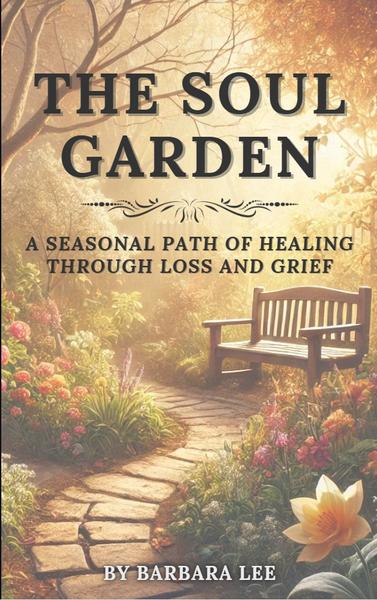
The Soul Garden: A Seasonal Path of Healing Through Loss and Grief by Barbara Lee. Available in digital and print at all major online bookshops worldwide.
CONVERSATIONS WITH MOM (Follow on Spotify)
An album by Jesse James Ferrell. Available May 15, 2026. Unscripted. Unfiltered. Raw conversations, late-night confessions, shared visions, and the emotional terrain only a mother and son can navigate together.
This is what it sounds like when two people who love each other refuse to keep any of it inside.
UNTAMED TODAY.
For people who refuse to live edited-down lives.
HAZTE VISIBLE
SÉ INDOMABLE
CONVIÉRTETE EN LEYENDA
TRES MANERAS DE CONVERTIRSE EN LEYENDA CON UNTAMED HOY
Cada artículo que publicamos comienza de la misma manera, con una conversación real. No un cuestionario, no un formulario, una conversación que va
donde terminan otras entrevistas. Lo que compartas decide qué Puerta Indómita se abrirá.
3 · La portada exclusiva
La experiencia completa. La entrevista sin prisas, el extenso reportaje editorial, un lanzamiento coordinado en todas las plataformas que utilizamos y tus historias convertidas en música original. La portada se reserva y asigna deliberadamente para una historia lo suficientemente importante como para merecerla.
2. Las 8 voces más destacadas
Un artículo completo e independiente sobre tu trabajo y la persona que lo creó. Escrito por alguien que te escuchó, basado en tus propias palabras y publicado como un espacio editorial permanente que puedes enviar a quien quieras, donde quieras, durante años. Este artículo se comparte con otras ocho voces, creando una conexión más profunda.
1. Lo indomable 26
Una cuidada selección mensual de veintiséis personas cuyo trabajo merece ser visto. Tu historia, contada con belleza y brevedad, junto a otras vidas que vale la pena conocer. La forma más sencilla de entrar en el mundo de Untamed Today y tener un lugar permanente en él.
TODAS LAS FUNCIONES INCLUYEN
-
Una conversación real. Grabada y dirigida por Jesse James, quien escucha atentamente. El reportaje se basa en lo que realmente sucedió en la habitación, con tu propia voz.
-
Una presencia que perdura. Lanzamos tu función en cuatro o más de nuestras plataformas, cada una con su propio estilo, y es probable que la repitamos hasta cuatro veces en un lapso de 48 meses. La mayoría de las funciones aparecen una sola vez y desaparecen. La tuya, en cambio, sigue presente gracias a nuestra promesa CODEX.
-
Tu historia, contada con música.* Canciones originales creadas directamente a partir de tus historias, con letra y música incluidas, publicadas con tu nombre. Los motores de búsqueda indexan los créditos musicales publicados, por lo que cada canción se convierte en una forma más de que el mundo te encuentre.
-
Diseño artesanal. Cada imagen es obra de Mike Calva, y usted recibe todos los derechos para usar las imágenes que producimos para sus propios fines, su prensa, su sitio web y sus ediciones.
-
Personas reales, en tiempo real. Respondemos y publicamos en directo, no a través de un programador que se hace pasar por una persona. Cuando tu función se actualiza, nos actualizamos con ella.
-
Una dirección permanente en la web. Tu artículo seguirá funcionando mucho después de su publicación, en kits de prensa, conversaciones para reservas y espacios a los que aún no has accedido.
*La música original está incluida en algunas funciones. El número de canciones, de una a tres, depende de la opción que elijas. Hablaremos de esto en nuestra primera conversación.
La mayoría de las plataformas venden visibilidad. Nosotros creamos un historial.
El siguiente paso es una breve conversación, de quince a veinte minutos, con un miembro de nuestro equipo. Sin presentaciones, sin presiones, sin compromiso. Tú nos cuentas, nosotros escuchamos y juntos encontramos el camino a seguir para que tu historia se abra paso.
Si en tu interior ya lo sabes, pídelo. La puerta nunca ha estado cerrada con llave.