
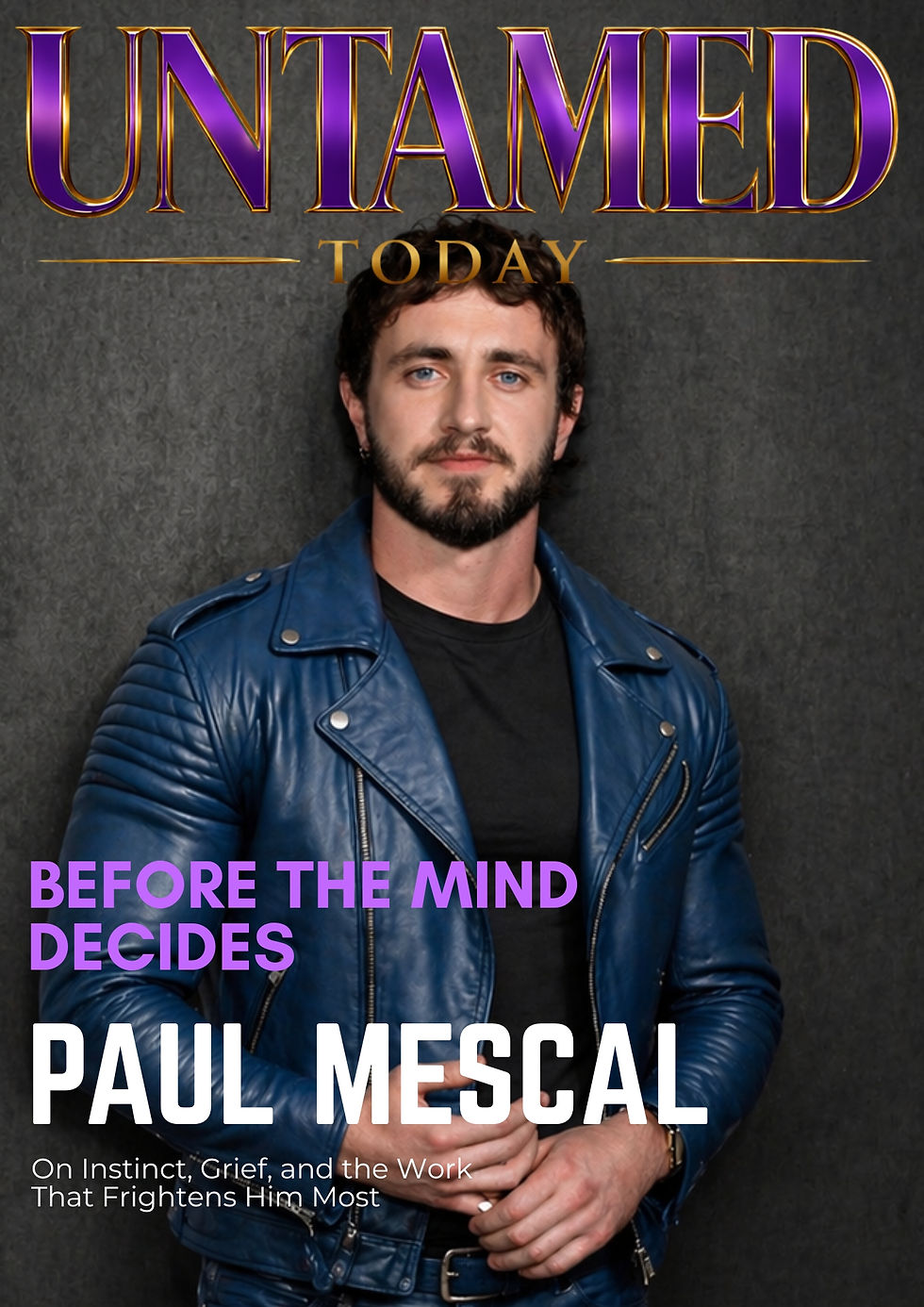
One life, up close
Before the Mind Decides
On Paul Mescal, the intelligence of the body, and the actor who keeps choosing the work that frightens him most.
UNTAMED TODAY INTERVIEWS
LIVING THE CODEX
UNTAMED TODAY · CULTURE · PROFILE
By UNTAMED TODAY Editorial

There is a moment in Aftersun where Paul Mescal's character, Calum, dances alone in the dark.
The camera finds him from across a crowded room, and then the crowd drops away. What remains is a man, in his body, in the dark, unreachable. You are watching grief happen in real time, in a person who does not know he is being watched. No technique visible. No performance offered. Just the terrible privacy of someone who has stopped pretending he is fine.
That performance earned him an Academy Award nomination for Best Actor, his first, for a tiny film directed by Charlotte Wells that he made at twenty-six. It is the clearest possible statement of what he does. He goes further than other actors go. Not louder. Not more expressive. Further in. Past the place where performance is legible, into the place where something true is happening, and he brings you with him whether you agreed to go or not.
The pitch before the stage
He grew up in Maynooth, County Kildare, a town with clear edges and a GAA pitch, and he trained on that pitch until his body learned something no classroom taught him. How to move with precise intention. How to read a room before the play develops. How to hold tension and release it at exactly the right moment. When he took that knowledge to The Lir Academy in Dublin, Ireland's most rigorous conservatory, it translated. Not as metaphor. As instrument.
You can see the athlete in how he acts. The set of the shoulders. The specific drag of how a character moves through a room. Hands that do not perform anything. These are not choices made in front of a mirror. They arrive from inside a person, and they read as such. There is a category of actor celebrated for their beauty, and a rarer one celebrated for the intelligence of their body. Mescal belongs to the second.
Present and private at once

The thing that makes him genuinely difficult to categorize is that he is physically commanding and fundamentally interior at the same time. He takes up space and recedes into himself in the same gesture. The warmth is real. The privacy is real. Neither cancels the other.
His best roles are built on exactly this. Connell in Normal People, desired by everyone and available to almost no one, a performance that earned him an Emmy nomination and made a plain silver chain one of the most-searched objects of 2020. Calum in Aftersun, the most present father carrying the most private ending. Andrew in All of Us Strangers, opposite Andrew Scott, wide open to love in the specific way only grief teaches. He is drawn to people who do not explain themselves, who hold complexity without offering it up for consumption. Most good writing lives in the gap between what someone shows and what they are. He finds that gap and inhabits it rather than describing it.
Power without permission
He was twenty-four when Normal People landed and the world opened all at once, with no runway. The choices that followed were not the obvious ones. Aftersun and All of Us Strangers were the opposite of the logical next move, small films about grief and memory. Then came Gladiator II, Ridley Scott's half-billion-dollar spectacle, in which he plays Lucius opposite Pedro Pascal's general. It looked like a swerve toward scale. It was made from the same place as everything else, the thing he could not stop thinking about. On why an action epic came to him, he was disarming about it. There is lots of latent trauma behind it all, he told Variety, and he is your guy for that.
The body did the work there too. He bulked to roughly 194 pounds for the role, after already gaining muscle to play Stanley Kowalski in A Streetcar Named Desire on stage, then stripped all of it back for Oliver Hermanus's The History of Sound. He trained for months to do his own horse stunt, and when Scott tried to pull him from it for insurance reasons, he did it anyway. The instrument is not a metaphor. He rebuilds it, film to film, from the inside.
Music as the thing that will not resolve
Music runs through his work in a way that is not decorative. Queen and David Bowie's “Under Pressure” in Aftersun, a song most people had heard a hundred times, suddenly unbearable. The Pet Shop Boys' “Always on My Mind” in All of Us Strangers, cited as some of the most emotionally precise music supervision in recent film. Both work because the films earned them, and because the grief in them does not arrive anywhere. It stays inside the not-knowing. That is the same thing his performances do. They do not resolve difficult material or redeem it. They stay inside it long enough that the person watching can finally breathe.
Refuses to be reduced

The chain. The heartthrob. The serious actor. The Oscar contender. The franchise star. Each of these narratives has been written about Paul Mescal, each is insufficient, and each keeps arriving anyway. He is twenty-nine, and he has already accumulated enough public story to make a smaller person choose one version and defend it. He does not. The image wants consistency and legibility, a story that does not change. The actor needs to be capable of contradiction. He protects that capacity, deliberately.
What is notable about Gladiator II is not that he survived the machinery of a global franchise. It is that he came out of it recognizable, the core intact, the instrument unblunted by the size of the stage. Two years ago he was still looking for permission, from directors, from the response, from the room. Now he can feel when something is working, and feel when he is performing instead of being, without needing the room to confirm it.
What he is moving toward is the work that frightens him, the kind where there is nowhere to hide, where if it does not work it really does not work. His body tends to know it is coming before his mind agrees to it. For him, that has always been the signal.
What he seems to want from all of it is simple and enormous. Not monuments. The work as company. Proof that someone else was inside this too, came out the other side, and made something from it. For the person watching in the dark, that is more than enough.
GOT SOMETHING INSIDE YOU?
A story. A book. A song. A painting. A season of life you finally made it through. A business built from the wreckage. A truth you have been carrying long enough that it is ready to become something. UNTAMED TODAY was built for exactly that, for the voices that do not fit anywhere else and do not apologise for it.
Bring it to Untamed Talks, or DM Jesse James Ferrell.
BE SEEN
BE UNTAMED
BECOME LEGENDARY
THREE WAYS TO BECOME LEGENDARY WITH UNTAMED TODAY
Every feature we publish begins the same way, with a real conversation. Not a questionnaire, not a form, a conversation that goes
where other interviews stop. What you share decides which Untamed Door to open.
3 · The Exclusive Cover
The complete experience. The unhurried interview, the full editorial feature at cover length, a coordinated release across every platform we touch, and your stories rendered as original music. The cover is reserved and assigned deliberately, for a story large enough to carry it.
2. Top 8 Voices
A full standalone feature on your work and the person behind it. Written by a human who listened, built around your real words, and published as a permanent editorial home you can send to anyone, anywhere, for years. This is a feature shared with eight other voices, creating a deeper connection.
1. The Untamed 26
A curated monthly collection of twenty-six people whose work deserves to be seen. Your story, told beautifully in brief, alongside others building lives worth reading about. The simplest way to enter the world of Untamed Today and hold a permanent place in it.
EVERY FEATURE INCLUDES
-
A real conversation. Recorded and conducted by Jesse James, who listens. The feature is built from what actually happened in the room, in your actual voice.
-
A presence that keeps working. We release your feature on four or more of our platforms, each rendered its own way, and it is likely we will repeat your feature up to four times over the course of 48 months. Most features appear once and disappear. Yours keeps arriving as part of our CODEX promise.
-
Your story, set to music.* Original songs created directly from your stories, lyrics and music both, published with your name featured. Search engines index published music credits, so every song becomes one more way the world finds you.
-
Design by human hands. Every visual is crafted by Mike Calva, and you receive full rights to use the images we produce for your own purposes, your press, your site, your edits.
-
Real people, in real time. We respond and post live, not through a scheduler pretending to be a person. When your feature moves, we move with it.
-
A permanent address on the web. Your feature keeps working long after publication, in media kits, booking conversations, and rooms you have not entered yet.
*Original music is included with select features. The number of songs, from one to three, depends on the door you enter through. We cover this in your first conversation.
Most platforms sell exposure. We build a record.
The next step is a short conversation, fifteen to twenty minutes, with a member of our team. No pitch, no pressure, no obligation. You talk, we listen, and together we find the Untamed Today Door your story walks through.
If something in you already knows, reach out. The door has never been locked.